Aerospace and Engineering Careers Event
The Aerospace Careers Programme (ACP) is a charity that exists to support the next generation of young engineers and pilots in the Aerospace industry. They work with partners from industry to promote and advise school students of various pathways into Aerospace.
Warwick School has worked with ACP over the past 5 years, and it was fantastic to have them return once more to present some of the latest technologies to students from our Foundation and from local state schools.
The day was led by Chris Marshall who runs a company in the UK that provides uncrewed aircraft systems for film, tv, agriculture and surveying industries – making use of drones and VR technology. His presentation also included visionary examples of “next generation” routes into Aerospace industries. These included AI powered Systems Engineering; Orbital Robotics Engineering; Commercial Space Mission Designers and Terraforming Engineering. Chris then discussed his own commercial enterprise and gave examples of the kind of aerial surveying he undertakes and also where AI can be utilised to interpret and map out ariel footage.
Lee Mason was next to present. He discussed his role as a digital artist and demonstrated real use cutting edge technology involving Artificial Intelligence, Virtual Reality, Augmented Reality and Blockchain tools to produce 3D/virtual designs.
Finally, Michael Stokes presented various ways to becoming a commercial pilot. Michael is in the final stages of acquiring his Airline Transport Pilot Licence theory certification and he built up his flying hours whilst working in industry.
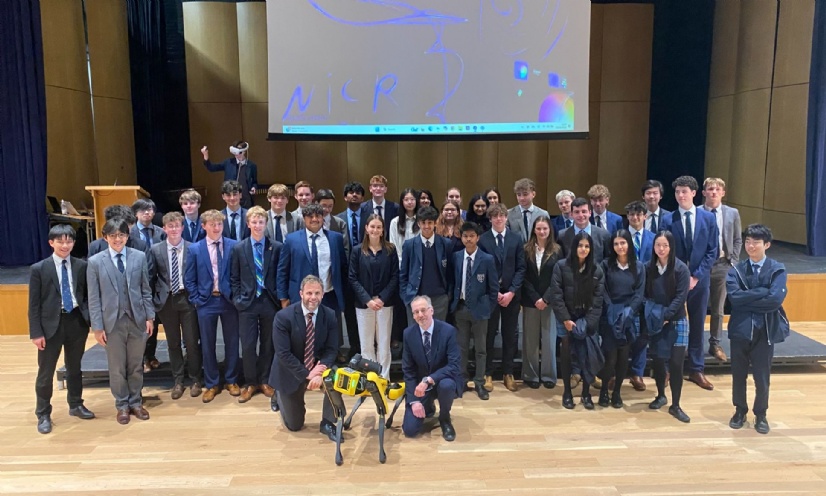
The students were then treated to an exciting and unique interaction with a Boston Dynamics robot dog called Spot. There are only 13 of these in the UK and cost around £100,000. For the presentation, Spot was equipped with speech recognition software that was connected to a Large Language Model AI tool. This allowed students the chance to ask it questions directly. Dialogue was not restricted to just technical information or even just English! Spot provided responses to students in any language they preferred, allowing questions in Danish and Mandarin alongside English without any problem.
After lunch, the breakout sessions offered a chance for students to explore some of the technology provided and discussed by ACP. This included simulators configured to train people how to fly drones; utilising VR tools to explore and create 3D digital artwork and design; 3D flight simulation and situational awareness using VR headsets. Of course, Spot continued to roam and interact with the students throughout the breakout sessions.
Feedback from students was overwhelmingly positive and they left the day enriched and armed with relevant information around the Aerospace industry.