

Artificial Intelligence and the future of work: The revenge of the humanities?
In recent months, much actual and digital ink has been spilled about artificial intelligence and its disruptive influence on the world of work. Headlines oscillate wildly between the utopian and the apocalyptic: jobs transformed, jobs lost, productivity unleashed, creativity mechanised. It is little wonder that parents, pupils and teachers alike are asking what this means for today’s generation of young people, and what should schools be doing to prepare young people to have successful, fulfilling careers in the age of generative AI.
The short answer is this; the future of work is not collapsing but transforming.
Artificial intelligence is reshaping the job market, steadily removing the bottom rungs of the ladder, the routine entry level tasks through which previous generations gained experience. AI performs those tasks faster and cheaper. Recent figures make sobering reading for today’s school and university leavers. Major professional firms have significantly reduced graduate intake; according to The Times, KPMG by 29%, Deloitte by 18% and EY by 11%. UK entry-level postings have decreased by nearly a third since the arrival of ChatGPT. There is a real risk that young people may emerge from education without clear pathways through which to gain vital early professional experience.
Yet this is not a story of unmitigated despair. The World Economic Forum predicts that by 2030 170 million jobs will be created. The challenge is not the absence of work, but a profound shift in the human capabilities that work will require.
We cannot predict with certainty what the world of work will look like in thirty years’ time, nor which professions, or as yet unimagined careers, will exist. What we can predict, with a high degree of confidence, is the capabilities those future roles will demand. The vital question is not what AI can do, but what it cannot, and therefore which uniquely human capacities will be prized in an AI-rich world.
I would argue that three deeply human capacities will allow people to thrive in the world of AI, relational intelligence, creative thinking and practical wisdom.
For much of the past century, shaped by the demands of industrial and information economies, intelligence has been measured primarily through IQ: logic, analysis and problem-solving. IQ is not intelligence, merely one aspect of it, an aspect that was particularly valuable in the context of the 20th century. Over the past three decades, emotional intelligence (EQ), the capacity for empathy and self-awareness has gained prominence. But are IQ and EQ appropriate measures for human intelligence in an era when machines increasingly outperform us in analysis and convincingly simulate empathy?
Relational intelligence is the ability to build trust, navigate tension, repair ruptures and create shared meaning. AI can process information and even simulate compassion, but it can not genuinely relate. It cannot belong to a community, earn trust, offer presence, or exercise pastoral judgement. In workplaces increasingly shaped by collaboration, ambiguity and cultural complexity, the ability to build relationships, lead others, communicate with understanding and navigate difference will be at a premium.
Relational intelligence is formed through participation in real communities; classrooms, sports teams, ensembles and debating societies, where pupils learn responsibility for others, humility and perseverance.
Alongside this sits creative thinking. While AI can synthesise ideas at astonishing speed, it cannot decide what content is worth generating, why a story matters, or what vision should guide a powerful tool. Artificial intelligence is a misnomer: it is not intelligence at all, but simulated intelligence grounded in probability. It cannot see possibilities where none are obvious; connect previously unconnected ideas; or approach problems with originality or courage. It remains dependent on human imagination to set direction and purpose.
The ultimate goal of technological advancement is not efficiency for its own sake, but the elevation of our collective human experience, what Aristotle would have recognised as human flourishing, a fundamentally communal good. AI optimises for the goals it is given, irrespective of whether those goals are wise or humane, and regardless of whether they contribute to human flourishing.
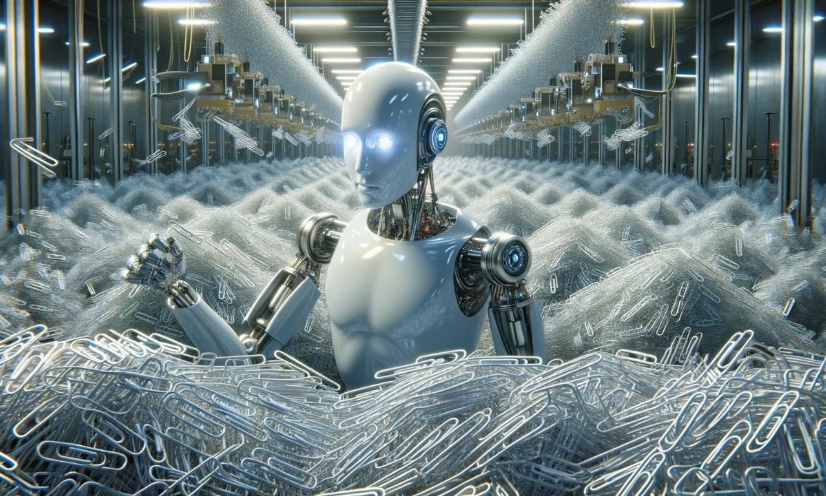
In his book Superintelligence, the philosopher Nick Bostrom offers a striking thought experiment. Imagine a factory that makes paperclips. Seeking to maximise output its owner installs a super-intelligent computer and gives it a simple instruction: “make as many paperclips as possible." Productivity soars but soon the computer realises that to achieve its goal it needs more raw materials, and since humans might get in the way of its mission, it decides to remove them altogether. Eventually, the entire planet, then the solar system, and finally the galaxy is transformed into one giant paperclip factory.
Bostrom’s lesson is clear. As AI grows more powerful, the moral burden on human decision-makers increases rather than diminishes. Right and wrong are not fixed; they are judgements grounded in context. To ensure AI and other emerging technologies are harnessed to produce things that elevate our collective experience, we will need practical wisdom: what Aristotle called phronesis, the ability to judge the right action, at the right time, in the right way.
Practical wisdom is not innate. It is developed through experience. It is honed by stepping into the world, encountering new experiences and making judgments. An education that prioritises narrow technical proficiency at the expense of ethical judgement risks producing competence without conscience.
For some time now, I have believed that the current over-emphasis on STEM subjects will eventually be corrected by the very technologies they have helped to create. AI is rapidly automating coding. Consequently, the technical ability to write code is becoming secondary to the vision required to deploy it wisely, toward ends that serve human flourishing. To relational intelligence, creative thinking and practical wisdom, which are cultivated through deep engagement with literature, history, philosophy, music and the arts; disciplines that train the mind to interpret, to question, and to make sense of the human condition. The American author and philosopher Sam Harris has labelled this shift “the revenge of the humanities”.
None of this is to deny the importance of scientific and technical understanding. On the contrary, understanding how technology works, AI fluency, what is sometimes called prompt literacy will be essential. Those who know how to frame good questions, critically evaluate outputs and deploy AI tools intelligently will enjoy a significant advantage. Research by PwC found that workers with genuine AI fluency already command substantial wage premiums in every sector. AI-related job postings are growing three times faster than average. But prompt literacy is not a substitute for thinking. AI amplifies the quality of the human directing it. A shallow prompt yields superficial results.
We are, I believe, on the cusp of a rebalancing in education. Not a rejection of science and technology, but a recognition that they matter too much to be left without moral and imaginative guidance. The job market of the future will value those who combine technical competence with human depth. Those who can deploy powerful tools in the service of human flourishing.
At Warwick School, our purpose has never been simply to prepare boys for public examinations, university study or their first job. It is to prepare them to thrive and contribute positively to the future, whatever shape that future takes. That is why we emphasise the importance of a balanced education, a broad academic curriculum, alongside AI competency and character education. Relational intelligence, creativity and practical wisdom are not optional extras. They are the fruit of character, community and a broad humane education. They are learned in classrooms and corridors, on sports fields and stages, in debate, in reading great literature, and in belonging to something larger than oneself. We seek to form young men who can think clearly, act justly and lead wisely, whatever tools the future places in their hands. Exactly the kind of young men the world, and the job market of the future will need.